IBM sold QRadar SaaS to Palo Alto Networks. SaaS is end-of-sale. On-prem is maintenance-only. Now they want you locked into the Palo Alto ecosystem. But is your stack all Palo Alto? Probably not. So why follow?
"I really didn't like QRadar to be honest. The solution is clunky. The interface could be much better. The integration capabilities within the product are not that great."
"The ease of use of the product plus support creates the most powerful security orchestration and automation platform. The team built a product with support to make sure the product is not stagnant but actually providing outcomes which we did not get with Splunk, Palo Alto (Demisto) or Tines which we have owned or tried. Already paying for itself within a couple of months."
G2 Verified Review
/01
"The platform is straightforward to use. It was quite intuitive for my team to get started. The skill level required is much lower than we needed with our SOAR."
G2 Verified Review
/02
"What truly sets Blink Ops apart is their unparalleled speed with the fastest TTA (Time to Automation) in the market, surpassing competitors by as much as a hundred fold."
Tal Morgenstern, Partner at Lightspeed Venture Partners
/03
"Perfect 5-star rating in GigaOm's 2024 SOAR Radar Report for implementation of AI Security Automation. 400% year-over-year revenue growth."
GigaOm Radar Report 2024
/04
The Real Problems with QRadar SOAR
These aren't our words. They're from actual QRadar SOAR users across PeerSpot, Gartner, and Capterra.
The Product Is Being Sunset
SaaS is end-of-sale. On-prem is in maintenance mode. No new features, no innovation. IBM's attention is elsewhere.
"As soon as contractual obligations run out, existing QRadar SaaS customers need to embrace XSIAM or migrate to a different vendor." — Forrester
Forced Into Palo Alto's Ecosystem
IBM and Palo Alto are pushing you toward Cortex XSIAM. "Free migration" sounds nice until you realize you're trading one vendor lock-in for a worse one. Unless your entire stack is Palo Alto, this makes zero sense. And if you know anything about PA acquisitions, expect a price hike on your next renewal. That's the pattern. Demisto customers saw it. QRadar customers will too.
Limited Integration Library
Around 300 integrations. In a world where your stack has 40+ tools, that's not enough. And the ones that exist need heavy lifting to configure.
"Integrating IBM Resilient with other applications can be very difficult and technically challenging."
Steep Learning Curve
Getting productive with QRadar SOAR takes serious ramp-up time. Advanced playbooks need programming experience. That's a problem when you're short-staffed.
"IBM QRadar SOAR requires a very high training curve."
Sub-Playbooks Are Painful
Building modular automation should be easy. With QRadar SOAR, sub-playbook dependencies are invisible and hard to manage.
Can't use sub-playbooks easily. View of dependency of modules are not visible."
Expensive for What You Get
Per-user or per-incident pricing that doesn't scale well. And now you're paying maintenance fees for a product that's not going anywhere.
"One of the most expensive tools for cloud-based SIEM tools."
QRadar SOAR vs. BlinkOps
This isn't about who has better playbooks. It's a different category of platform.
Capability
BlinkOps
IBM QRadar SOAR
AI Agent Builder
No-code agent builder. Define role, responsibilities, abilities, constraints. Deploy custom AI agents for triage, enrichment, response.
Does not exist. No agent capabilities. Playbook-only architecture.
AI Workflow Builder
Builder Copilot. Describe what you want in plain English. AI generates full multi-step workflows in seconds.
Manual drag-and-drop only. Every step configured by hand. Advanced playbooks require programming.
AI Workflow Modifier
Modify existing workflows with natural language prompts. AI transforms step outputs, generates JQ commands from plain English.
Manual edits only. Change one step, debug three more.
Analyst Copilot
AI copilot inside case management. Understands full incident context. Runs enrichment, suggests actions via chat.
No analyst copilot. Analysts work manually through each case.
Agentic Workflows
Hybrid approach. Mix deterministic steps with micro-agent reasoning steps in the same workflow. Agent handles ambiguity, automation handles speed.
Playbooks only. No reasoning. Every path must be hardcoded.
Dynamic Workflow Creation
Agents select and execute workflows based on real-time context. No pre-mapped decision trees needed.
"Dynamic playbooks" adapt conditions, but no AI-driven workflow selection. Still rule-based branching.
Integrations
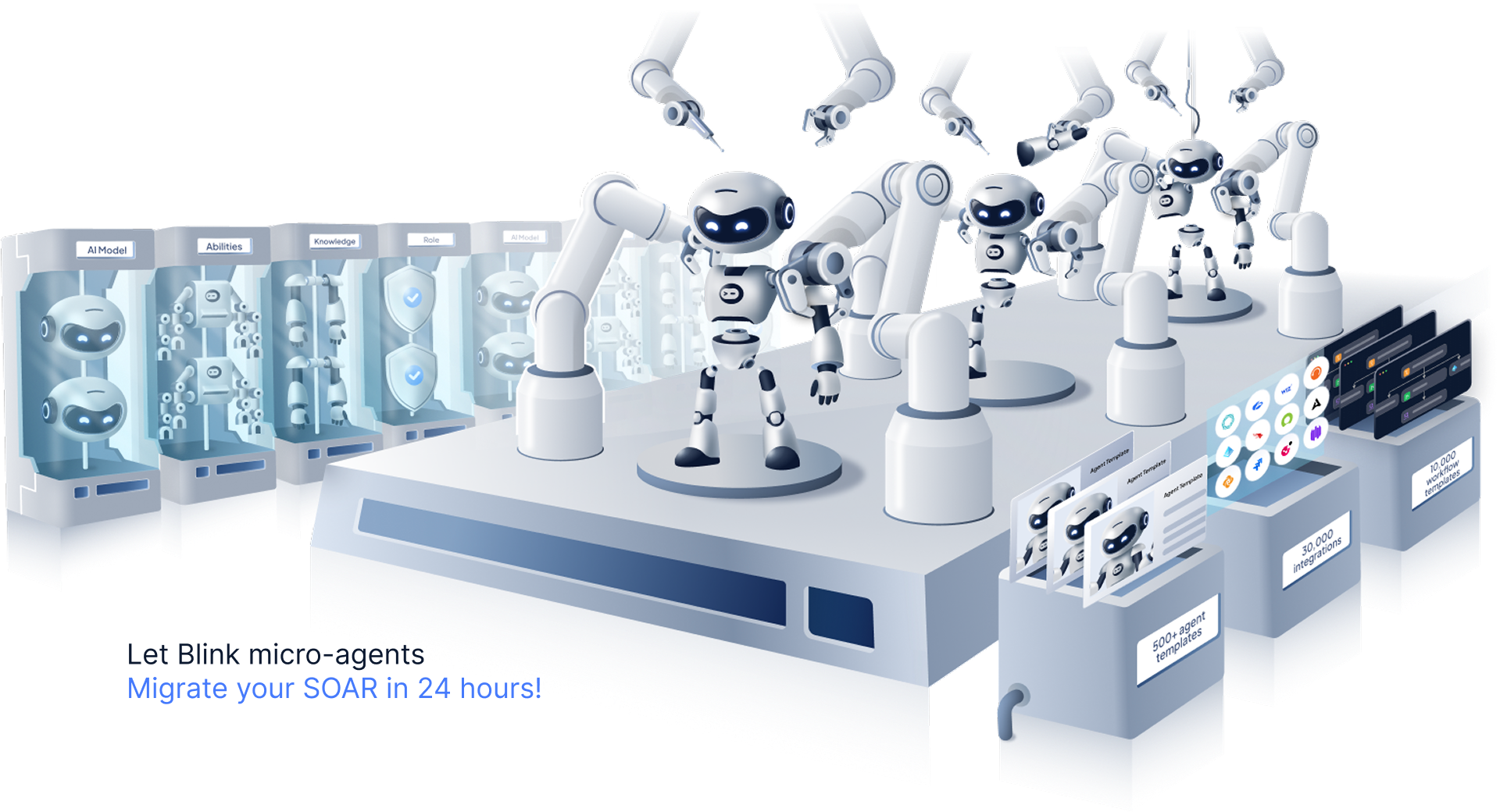
30,000+ built-in integrations. Connect to anything. Custom integrations in minutes.
~300 integrations. Limited app library. Custom connectors are painful and time-consuming.
No native structured storage. Need external databases or custom scripts for stateful data.
Self-Service Portal
Expose any workflow as a self-service app. Web Forms for interactive data collection. Works via portal, Slack, Teams, Zoom.
Limited. No self-service portal for non-SOC users. No web form builder.
Time to Production
Minutes. AI generates workflow from prompt. Connect integrations, publish, done.
Days to weeks. Manual configuration, programming for advanced flows, vendor PS engagement typical.
Your Migration Path
You're going to move off QRadar SOAR anyway. IBM made that decision for you. The only question is whether you follow them into Palo Alto's ecosystem or go somewhere that actually fits your stack.
Audit & Map
We map your existing QRadar SOAR playbooks, integrations, and workflows. Blink's tooling can import existing playbook logic automatically.
Week 1
Build & Connect
Recreate your workflows in Blink using Builder Copilot. With 30,000+ integrations, your existing stack connects in minutes, not days.
Week 2-3
Deploy & Expand
Go live with your migrated workflows. Then add what QRadar never had: AI agents for triage, analyst copilot, self-service portal, and stateful tables.
Week 4
Try BlinkOps Today!
Don't let IBM's exit strategy lock you into Palo Alto's ecosystem. Unless your whole stack is PA, there's no reason to follow. See how BlinkOps replaces QRadar SOAR and gives you capabilities it never had.